
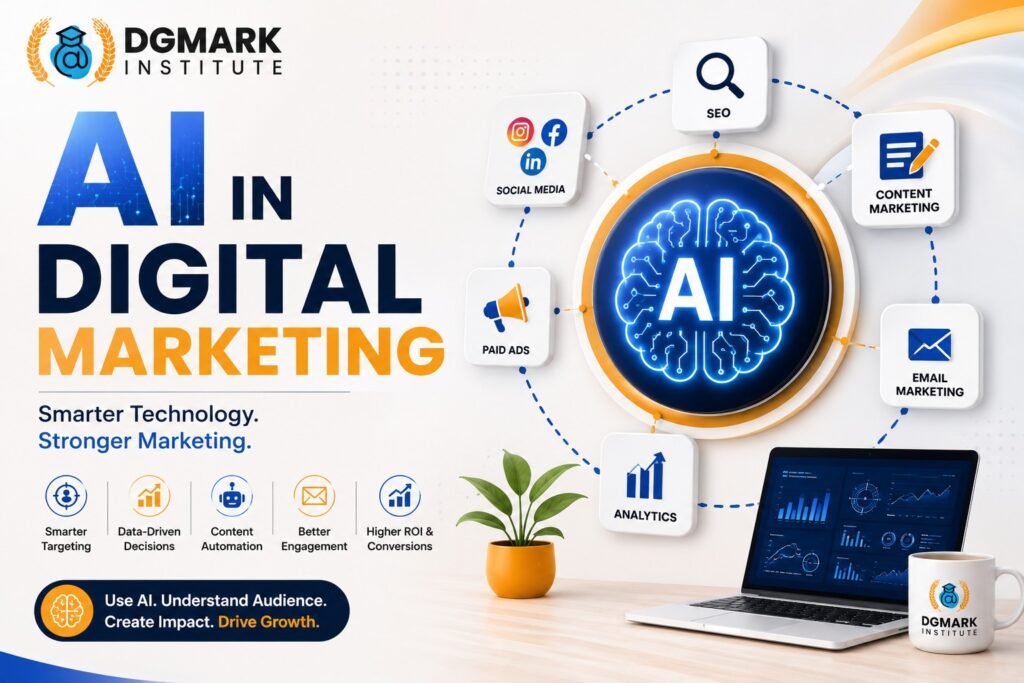
AI in digital marketing is changing landscape by integrating AI tools into its practical digital marketing curriculum. As artificial intelligence becomes an increasingly important part of marketing, businesses and marketers are using AI to analyze data, understand audiences, create content, optimize campaigns, improve SEO, and automate repetitive tasks. DGmark Institute’s current curriculum combines core digital marketing skills with AI tools, performance marketing, SEO, social media marketing, Google Ads, and marketing analytics.
Digital marketing has evolved significantly over the last decade. Businesses once depended heavily on traditional advertising, but today, customers discover brands through Google searches, social media, online advertisements, websites, videos, email, and other digital channels. With millions of users interacting with digital platforms every day, marketers have access to enormous amounts of information.
The challenge is no longer simply collecting data. The challenge is understanding that data and converting it into useful marketing decisions.
This is where Artificial Intelligence (AI) is making a major difference.
AI can process large amounts of information, identify patterns, generate ideas, automate repetitive activities, and support marketers in making faster, data-driven decisions. As a result, AI is becoming an important part of modern digital marketing strategies.
What Is AI in Digital Marketing?
AI in digital marketing refers to the use of artificial intelligence technologies to support and improve marketing activities.
Instead of performing every marketing task manually, marketers can use AI-powered tools to assist with activities such as:
- Keyword research
- Content creation
- SEO analysis
- Audience research
- Competitor analysis
- Social media content
- Advertising optimization
- Marketing automation
- Customer personalization
- Data analysis
- Reporting
AI does not necessarily mean that humans are removed from the marketing process. In many cases, it works as a productivity and decision-support tool.
For example, a marketer can use AI to generate several content ideas, analyze campaign data, or identify potential keywords. The marketer can then review the information, apply strategic thinking, and make the final decision.
This combination of AI technology and human expertise is becoming increasingly valuable.
Why Is AI Important in Digital Marketing?
Modern marketing is highly data-driven. Every interaction can generate information about customer behavior.
A website can provide information about visitor behavior. Search engines provide insights into what people are looking for. Social media platforms provide engagement data. Advertising platforms provide information about clicks, conversions, audiences, and spending.
Analyzing all this information manually can be time-consuming.
AI can help marketers process and organize this information more efficiently. It can identify patterns and highlight areas that deserve attention.
For example, AI may help identify:
- Which audience segments are engaging with a campaign
- Which content topics are receiving more attention
- Which keywords may have marketing potential
- Which advertisements are performing better
- Which pages may require optimization
- Which customer behaviors indicate purchase intent
This can help marketers spend less time on repetitive analysis and more time on strategy and creativity.
AI and Search Engine Optimization
Search Engine Optimization, or SEO, is one of the most important areas of digital marketing where AI can provide assistance.
SEO involves improving a website so that it can achieve better visibility in search engines and attract relevant organic traffic.
Traditional SEO involves activities such as keyword research, competitor analysis, content optimization, technical optimization, internal linking, and performance monitoring.
AI tools can assist marketers with several of these activities.
AI-Powered Keyword Research
Finding the right keywords is an important part of SEO.
AI can help marketers identify related search terms, understand search intent, group keywords into topics, and discover potential content opportunities.
For example, instead of targeting only a broad keyword such as “digital marketing,” marketers can use AI-assisted research to explore related topics such as digital marketing courses, SEO training, performance marketing, Google Ads, social media marketing, and AI marketing tools.
The marketer can then evaluate which keywords are actually relevant to the business.
AI and Content Optimization
AI can also help analyze content and identify opportunities for improvement.
It can assist marketers in creating outlines, identifying related topics, improving readability, and ensuring that content addresses common questions.
However, marketers should not rely completely on AI-generated content.
High-quality content still needs human review, accurate information, original insights, and a clear understanding of the target audience.
DGmark Institute’s digital marketing curriculum includes SEO alongside AI tools, giving learners exposure to both traditional marketing fundamentals and newer AI-supported workflows.
AI in Content Marketing
Content marketing involves creating useful and relevant content to attract, educate, and engage an audience.
AI has made the content creation process significantly faster.
Marketers can use AI to brainstorm:
- Blog topics
- Social media ideas
- Video concepts
- Headlines
- Content outlines
- Ad copy
- Email ideas
- Frequently asked questions
For example, a marketer planning a blog about SEO can ask an AI tool to identify possible subtopics. The marketer can then research those topics and create a comprehensive article.
AI can therefore support the research and ideation stage of content marketing.
However, simply generating content is not enough.
Brands still need a unique voice and authentic communication. Human marketers are responsible for making sure the content reflects the brand’s values and provides genuine value to readers.
AI in Social Media Marketing
Social media marketing involves creating content, engaging with audiences, analyzing performance, and maintaining a consistent brand presence.
AI can support social media marketers in several ways.
It can help generate content ideas, identify trends, analyze engagement patterns, and assist with content planning.
For example, if a brand notices that educational videos receive more engagement than static posts, marketers can use this information when planning future content.
AI can also help marketers analyze large amounts of social media data more efficiently.
However, social media remains a human-focused channel. Creativity, communication, cultural understanding, and emotional connection are still essential.
AI can suggest ideas, but marketers need to decide whether those ideas are appropriate for their audience.
DGmark Institute includes Social Media Marketing as part of its digital marketing training, alongside practical learning and AI-focused tools. (Dgmark Institute)
AI in Google Ads and Performance Marketing
Paid advertising is another area where AI is becoming increasingly important.
Google Ads and other advertising platforms already use automation and machine learning to assist advertisers with bidding, targeting, optimization, and campaign performance.
Marketers can also use AI tools to support the analysis of advertising data.
AI can help marketers identify patterns involving:
- Audience behavior
- Ad performance
- Conversion trends
- Campaign results
- Search terms
- Budget allocation
For example, if one campaign generates significantly better results than another, marketers can analyze the available data and decide where to allocate more resources.
DGmark Institute’s curriculum includes Google Ads and Performance Marketing, with its current program also emphasizing AI-integrated learning and practical campaign execution.
This combination can help learners understand both the fundamentals of advertising and the role of technology in campaign management.

AI and Marketing Analytics
Marketing analytics is about understanding whether marketing activities are actually producing results.
Marketers monitor metrics such as:
- Website traffic
- Click-through rates
- Conversion rates
- Cost per lead
- Customer acquisition cost
- Engagement
- Return on advertising spend
AI can help analyze these metrics and identify patterns.
For example, instead of manually examining thousands of data points, AI-supported systems can help highlight unusual changes or trends that marketers should investigate.
This allows marketers to focus their attention on important areas.
DGmark Institute’s current curriculum includes Marketing Analytics and GA4 alongside SEO, Performance Marketing, and AI tools.
AI and Personalization
Customers are exposed to hundreds of marketing messages every day. Generic communication can therefore struggle to capture attention.
AI can help businesses create more personalized marketing experiences.
For example, an online store can analyze customer behavior and recommend products based on previous interactions.
Similarly, businesses can create different marketing messages for different audience segments.
A new visitor may receive introductory information about a product, while an existing customer may receive information about related products or services.
Personalization can make marketing communication more relevant and useful.
AI for Competitor Research
Understanding competitors is an important part of developing a digital marketing strategy.
AI tools can help marketers analyze publicly available competitor information and identify patterns.
Marketers may use AI-assisted research to examine:
- Competitor content
- Keyword opportunities
- Advertising approaches
- Social media activity
- Website positioning
- Content topics
- Market trends
The goal is not to copy competitors.
Instead, competitor research can help marketers identify market gaps and discover opportunities to differentiate their brands.
AI Chatbots and Customer Engagement
AI-powered chatbots are another popular application of artificial intelligence in digital marketing.
Businesses can use chatbots to answer common questions, provide basic information, guide website visitors, and support lead generation.
For example, a visitor may ask about a course, service, pricing, or availability. A chatbot can provide an immediate response to frequently asked questions.
This can improve the speed of customer communication.
However, human support remains important for complicated questions or situations requiring personalized assistance.
The most effective approach is often to use AI for routine interactions while allowing human teams to handle complex customer requirements.
AI Tools Used in Digital Marketing
AI tools are becoming an important part of modern marketing education.
DGmark Institute’s website states that its curriculum includes 33+ AI tools, while its broader program highlights learning across more than 50 digital marketing tools and platforms.
Its AI-focused curriculum has included tools such as:
- ChatGPT
- Gemini
- Copy.ai
- QuillBot
- Adobe Firefly
- Predis.ai
- ElevenLabs
- HeyGen
- Synthesia
- Canva AI
- Surfer
- Perplexity
The exact tools available in AI platforms continue to change rapidly, which makes practical exposure particularly important for digital marketing learners.
DGmark Institute’s 2025 brochure also specifically describes its AI module as combining learning about AI tools with practical experience using them.
Benefits of AI in Digital Marketing
AI offers several potential advantages to marketers and businesses.
1. Saves Time
AI can automate or speed up repetitive marketing tasks.
2. Supports Data Analysis
AI can process large amounts of marketing data and identify useful patterns.
3. Improves Efficiency
Marketers can spend less time on repetitive activities and more time on strategy.
4. Supports Personalization
AI can help businesses create more relevant experiences for different audience segments.
5. Helps Generate Ideas
AI can provide content topics, campaign concepts, headlines, and creative directions.
6. Supports Campaign Optimization
AI-powered systems can help marketers identify areas where campaigns may need improvement.
7. Encourages Data-Driven Marketing
AI can help marketers make decisions based on data rather than assumptions.
Challenges of AI in Digital Marketing
While AI provides many advantages, it also has limitations.
Accuracy
AI-generated information can sometimes contain errors. Marketers must verify important information before publishing or using it.
Lack of Human Creativity
AI can generate ideas, but human creativity and original thinking remain important.
Privacy
Businesses must handle customer information responsibly and follow applicable privacy requirements.
Over-Automation
Using AI for every marketing activity can make brand communication feel generic.
Quality Control
AI-generated content needs human review to ensure that it is accurate, relevant, original, and aligned with the brand.
Therefore, businesses should focus on using AI strategically rather than using AI simply because it is available.
AI vs Human Marketers: Which Is Better?
The future of marketing is unlikely to be simply about AI versus humans.
Instead, AI and human marketers can complement each other.
AI is particularly useful for:
- Data processing
- Automation
- Pattern recognition
- Research assistance
- Repetitive tasks
- Content ideation
Humans are particularly important for:
- Strategy
- Creativity
- Emotional understanding
- Brand positioning
- Relationship building
- Decision-making
- Critical thinking
The strongest marketing teams can combine both.
A marketer who knows how to use AI tools effectively can potentially work more efficiently while still applying human judgment to important decisions.
How DGmark Institute Is Integrating AI Into Digital Marketing Education
As AI changes the marketing industry, digital marketing education also needs to evolve.
DGmark Institute states that its curriculum is continuously updated with AI tools, performance marketing strategies, SEO developments, and real-time case studies. Its programs emphasize practical learning, live projects, campaign execution, and hands-on experience.
Its current digital marketing program includes areas such as:
- SEO
- Google Ads
- Social Media Marketing
- Performance Marketing
- AI Tools
- Marketing Analytics
- Website development
- Practical campaign execution
The institute also highlights live projects and practical training as important components of its learning approach. This type of learning can help students understand not only what AI tools are, but also how they can be incorporated into actual digital marketing workflows.
Why Learning AI Is Becoming Important for Digital Marketers
Digital marketing is continuously evolving.
A marketer today may need to understand SEO, social media, paid advertising, analytics, content, websites, and AI tools.
Learning AI can help marketers adapt to these changes.
Students and professionals who understand how to combine marketing fundamentals with AI-powered tools can develop a broader skill set.
For beginners, the most important thing is not to learn every AI tool available.
Instead, they should understand the fundamentals of digital marketing first and then learn how AI can improve those processes.
For example:
Learn SEO → Use AI to support keyword research and content analysis.
Learn Google Ads → Use AI-supported insights to analyze campaign performance.
Learn social media → Use AI to support content ideation and analysis.
Learn analytics → Use AI to identify patterns in marketing data.
This creates a stronger foundation than relying on AI without understanding marketing fundamentals.
The Future of AI in Digital Marketing
AI will likely continue to influence almost every part of digital marketing.
Search engines and digital platforms are becoming increasingly intelligent. Advertising systems are becoming more automated. Content creation is becoming faster. Customer experiences are becoming more personalized.
At the same time, marketers will need to become better at evaluating information, developing strategies, understanding customers, and maintaining authenticity.
The future marketer may therefore need to be both a marketing strategist and an AI-enabled professional.
Rather than asking whether AI will replace digital marketers, businesses and professionals should consider a more useful question:
How can digital marketers use AI to become more effective?
That shift in thinking can help businesses use technology without losing the human element of marketing.
Conclusion
Artificial Intelligence is transforming digital marketing by changing how businesses research audiences, create content, analyze data, optimize campaigns, improve SEO, and communicate with customers.
AI can save time, support data analysis, improve personalization, and automate repetitive marketing activities. However, it cannot replace the need for human strategy, creativity, critical thinking, and decision-making.
For aspiring digital marketers, learning how AI works alongside SEO, Google Ads, social media marketing, performance marketing, and analytics can be a valuable part of professional development.
DGmark Institute is incorporating AI tools into its digital marketing curriculum while maintaining a practical focus on core marketing skills, live projects, campaign execution, and industry-oriented training. (Dgmark Institute)
As the industry continues to evolve, the marketers who learn to combine marketing knowledge with AI capabilities can be better prepared for the opportunities created by the next generation of digital marketing.
Frequently Asked Questions (FAQs)
1. What is AI in digital marketing?
AI in digital marketing involves using artificial intelligence to support activities such as SEO, content creation, advertising, analytics, personalization, and automation.
2. How does AI help digital marketers?
AI helps marketers analyze data, generate ideas, automate repetitive tasks, understand audiences, optimize campaigns, and improve marketing efficiency.
3. Can AI replace digital marketers?
AI can automate certain tasks, but digital marketers are still needed for strategy, creativity, critical thinking, brand communication, and decision-making.
4. How is AI used in SEO?
AI can assist with keyword research, search-intent analysis, competitor research, content optimization, and identifying potential SEO opportunities.
5. How is AI used in Google Ads?
AI and machine learning can support advertising activities such as bidding, targeting, campaign optimization, and performance analysis.
6. Can AI create social media content?
Yes. AI can help generate content ideas, captions, post concepts, and creative directions. Human review is still important before publishing.
7. Why should digital marketers learn AI tools?
Learning AI tools can help marketers work more efficiently, analyze information faster, automate repetitive activities, and adapt to changing industry requirements.