
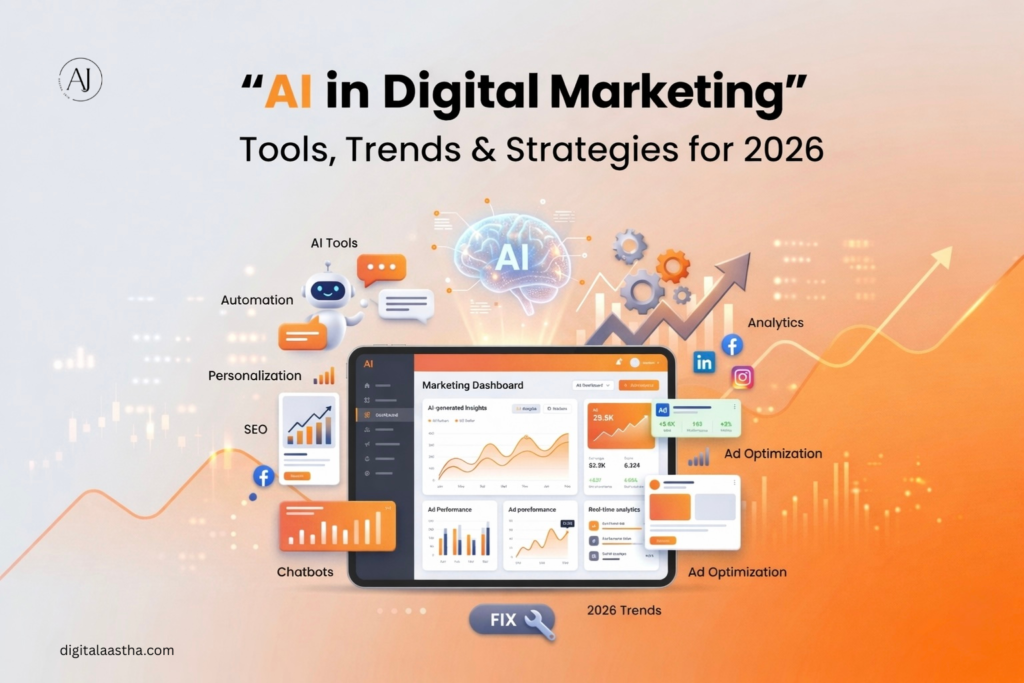
Artificial Intelligence (AI) has rapidly transformed from a futuristic concept into one of the most influential technologies driving business growth worldwide. In 2026, AI is no longer a luxury reserved for large enterprises—it has become an essential component of successful digital marketing strategies for businesses of every size. From automating repetitive tasks to delivering highly personalized customer experiences, AI is reshaping how brands connect with their audiences and achieve measurable marketing results.
The digital marketing landscape has become increasingly competitive. Consumers expect relevant content, instant responses, and seamless interactions across multiple channels. Traditional marketing methods alone can no longer keep pace with these expectations. Businesses that leverage AI can analyze massive volumes of customer data, predict buying behavior, optimize advertising campaigns, and create personalized experiences at scale.
Whether you’re a small business owner, digital marketer, entrepreneur, or marketing student, understanding how AI is changing digital marketing in 2026 is essential for staying competitive. Companies that embrace AI-driven marketing strategies are gaining significant advantages in customer engagement, lead generation, conversion optimization, and overall return on investment (ROI).
This comprehensive guide explores how artificial intelligence is transforming digital marketing, the latest AI trends, practical business applications, essential AI-powered tools, benefits, challenges, and actionable strategies that marketers can implement today.
Understanding Artificial Intelligence in Digital Marketing
Artificial Intelligence refers to computer systems that can perform tasks requiring human intelligence. These tasks include learning from data, recognizing patterns, making predictions, understanding language, and automating decision-making.
In digital marketing, AI enables businesses to:
- Analyze customer behavior
- Automate repetitive marketing tasks
- Create personalized content
- Improve advertising performance
- Predict future customer actions
- Enhance customer support
- Optimize search engine strategies
Rather than replacing marketers, AI acts as a powerful assistant that helps professionals make smarter, faster, and more data-driven decisions.
Why AI Has Become Essential in 2026
Consumer expectations have changed dramatically over the past few years.
Modern customers expect:
- Personalized recommendations
- Instant customer support
- Relevant advertisements
- Fast-loading websites
- Seamless shopping experiences
- Consistent communication across platforms
Meeting these expectations manually has become nearly impossible.
Artificial Intelligence allows marketers to deliver these experiences efficiently while reducing operational costs and improving campaign performance.
The Evolution of Digital Marketing Before AI
Before AI became mainstream, digital marketing relied heavily on manual work.
Marketers spent hours on :
- Researching keywords
- Writing ad copies
- Scheduling social media posts
- Segmenting email lists
- Managing customer data
- Analyzing campaign performance
Decision-making often depended on historical reports rather than real-time insights.
Although these methods were effective, they required significant time, effort, and resources.
AI has dramatically improved this process.
How AI is Revolutionizing Digital Marketing in 2026
1. AI-Powered Content Creation
Creating high-quality content consistently is one of the biggest challenges for marketers.
AI-powered writing assistants now help businesses:
- Generate blog outlines
- Draft articles
- Create social media captions
- Write email campaigns
- Produce product descriptions
- Generate ad copy
- Brainstorm content ideas
Instead of replacing human creativity, AI accelerates the content creation process, allowing marketers to focus on strategy, storytelling, and brand messaging.
Businesses using AI-assisted content production can publish more frequently while maintaining consistency across channels.
2. Personalized Customer Experiences
Personalization has evolved far beyond adding a customer’s first name to an email.
AI analyzes customer behavior, browsing history, purchase patterns, interests, and engagement data to deliver highly customized experiences.
Examples include:
- Personalized product recommendations
- Dynamic website content
- Customized email campaigns
- Individualized landing pages
- Personalized advertisements
Customers are more likely to engage with brands that understand their preferences.
3. Smarter Customer Segmentation
Traditional audience segmentation grouped customers using basic demographics.
AI creates far more detailed audience segments using:
- Online behavior
- Purchase frequency
- Engagement history
- Device usage
- Customer lifetime value
- Buying intent
This enables businesses to deliver more relevant marketing messages.
4. Predictive Analytics
One of AI’s most valuable capabilities is predicting future customer behavior.
Predictive analytics helps marketers answer questions like:
- Which customers are likely to purchase?
- Which leads may become inactive?
- Which campaigns will perform best?
- Which products will become popular?
Businesses can proactively adjust their marketing strategies instead of reacting after campaigns underperform.
5. AI-Driven SEO Optimization
Search engine optimization has become increasingly data-driven.
AI helps marketers:
- Discover keyword opportunities
- Analyze competitors
- Identify search intent
- Optimize content structure
- Improve internal linking
- Generate SEO recommendations
Modern AI tools can also identify content gaps and suggest topics likely to rank well on search engines.
6. Voice Search Optimization
Voice search continues to grow through smartphones, smart speakers, and virtual assistants.
AI helps marketers optimize content for conversational search queries by:
- Identifying natural language keywords
- Improving FAQ content
- Understanding search intent
- Structuring content for featured snippets
Businesses optimizing for voice search gain greater visibility in search results.
7. AI in Social Media Marketing
Managing multiple social media platforms manually is time-consuming.
AI now assists marketers by:
- Scheduling posts
- Recommending posting times
- Generating captions
- Identifying trending topics
- Monitoring engagement
- Responding to common customer inquiries
AI also analyzes audience behavior to determine which content formats generate the highest engagement.
8. Intelligent Chatbots and Virtual Assistants
Customer service has improved significantly through AI-powered chatbots.
Modern chatbots can:
- Answer frequently asked questions
- Recommend products
- Schedule appointments
- Capture leads
- Process orders
- Provide customer support 24/7
Businesses benefit from faster response times and improved customer satisfaction.
9. AI-Powered Email Marketing
Email marketing remains one of the highest ROI marketing channels.
AI enhances email campaigns by:
- Predicting optimal send times
- Personalizing subject lines
- Segmenting audiences automatically
- Generating personalized recommendations
- Identifying inactive subscribers
This leads to higher open rates and improved conversion rates.
10. Programmatic Advertising
AI has transformed digital advertising through programmatic buying.
Instead of manually purchasing ad placements, AI automatically:
- Bids for advertisements
- Optimizes targeting
- Adjusts budgets
- Tests creatives
- Improves campaign performance
This ensures advertising budgets are spent more efficiently.
AI in Paid Advertising
Advertising platforms increasingly rely on machine learning algorithms.
AI helps marketers:
- Identify high-converting audiences
- Optimize bidding strategies
- Improve ad relevance
- Reduce cost per acquisition
- Increase conversion rates
Platforms such as Google Ads and Meta Ads use AI extensively to optimize campaign performance automatically.
AI and Customer Journey Mapping
Understanding customer journeys has become easier with AI.
AI analyzes multiple touchpoints including:
- Website visits
- Social media interactions
- Email engagement
- Search history
- Purchase behavior
This provides marketers with a complete view of the customer lifecycle.
AI in Marketing Automation
Marketing automation has become significantly smarter.
AI automates:
- Lead nurturing
- Follow-up emails
- Customer onboarding
- CRM updates
- Campaign reporting
- Sales notifications
Automation allows teams to focus more on strategy than repetitive tasks.
AI-Powered Data Analytics
Modern businesses generate enormous amounts of customer data.
AI converts this data into actionable insights by identifying:
- Customer preferences
- Sales trends
- Campaign performance
- Emerging opportunities
- Areas needing improvement
Real-time reporting allows marketers to optimize campaigns continuously.
AI in Video Marketing
Video continues to dominate digital marketing.
AI supports video creation by helping with:
- Script generation
- Caption creation
- Voice synthesis
- Video editing
- Thumbnail recommendations
- Performance analysis
This makes professional video production more accessible for businesses.
Benefits of AI in Digital Marketing
Businesses adopting AI experience numerous advantages.
Increased Efficiency
Routine tasks become automated, saving valuable time.
Better Decision-Making
AI provides accurate, data-driven insights.
Improved Customer Experience
Personalization enhances customer satisfaction.
Higher Conversion Rates
Better targeting improves campaign performance.
Cost Savings
Automation reduces manual effort and operational costs.
Faster Campaign Optimization
Real-time analysis allows immediate improvements.
Challenges of AI in Digital Marketing
Although AI offers many benefits, businesses should also understand its limitations.
Data Privacy
Businesses must comply with privacy regulations when collecting customer data.
Human Oversight
AI-generated content still requires human review for accuracy and brand consistency.
Learning Curve
Teams need training to effectively use AI-powered marketing tools.
Technology Costs
Some advanced AI platforms require financial investment.
Despite these challenges, the long-term benefits often outweigh the initial costs.
Best AI Tools for Digital Marketers in 2026
Marketers increasingly rely on AI-powered tools for daily operations.
Popular categories include:
- Content writing assistants
- SEO optimization platforms
- Email marketing automation
- Social media scheduling tools
- CRM systems
- Chatbot platforms
- Graphic design assistants
- Video editing software
- Data analytics platforms
- Advertising optimization tools
Selecting the right combination depends on business goals and marketing strategy.
Practical Applications Across Industries
AI benefits nearly every industry.
E-commerce
- Product recommendations
- Cart abandonment recovery
- Personalized promotions
Healthcare
- Appointment reminders
- Patient communication
- Educational campaigns
Education
- Personalized learning
- Student engagement
- Course recommendations
Real Estate
- Property recommendations
- Lead qualification
- Automated follow-ups
Digital Marketing Agencies
- Campaign optimization
- Content generation
- Client reporting
- Keyword research
How Small Businesses Can Start Using AI
Small businesses don’t need massive budgets to benefit from AI.
Begin with:
- AI writing assistants
- Chatbots
- Email automation
- Social media scheduling
- SEO optimization tools
- Customer analytics
Gradually expand AI usage as business needs evolve.
Future Trends in AI Marketing
Looking ahead, AI will continue transforming digital marketing through:
- Hyper-personalized customer experiences
- Predictive customer service
- Advanced conversational AI
- AI-generated video content
- Smarter advertising algorithms
- Voice commerce
- Visual search optimization
- Real-time content personalization
- Autonomous marketing campaigns
Businesses that adopt these innovations early will gain significant competitive advantages.
Actionable Tips for Marketers
To leverage AI successfully:
- Use AI to enhance—not replace—human creativity.
- Combine automation with authentic storytelling.
- Regularly analyze campaign performance.
- Keep customer privacy a priority.
- Continuously test and optimize AI-generated content.
- Invest in team training.
- Focus on delivering genuine value to customers.
Final Thoughts
Artificial Intelligence has fundamentally transformed digital marketing in 2026, changing how businesses create content, engage audiences, optimize campaigns, and measure success. What was once considered an emerging technology has now become an indispensable part of modern marketing strategies. From predictive analytics and intelligent automation to personalized customer experiences and AI-driven advertising, businesses are using AI to work more efficiently and achieve better results.
However, AI is not a replacement for creativity, strategic thinking, or human relationships. The most successful marketers combine AI’s speed, scalability, and analytical capabilities with human insight, storytelling, and emotional intelligence. This balance enables brands to deliver authentic experiences while maximizing productivity and return on investment.
For businesses of all sizes, adopting AI is no longer simply about staying current—it is about staying competitive. Whether you’re a startup seeking faster growth, an established company optimizing marketing operations, or a digital marketer looking to improve campaign performance, AI provides the tools needed to make smarter decisions, understand customers more deeply, and create highly effective marketing strategies.
As AI technology continues to evolve, marketers who embrace continuous learning, ethical practices, and innovation will be best positioned to thrive. The future of digital marketing belongs to businesses that successfully integrate artificial intelligence into their marketing ecosystem while maintaining a customer-first approach. By doing so, they can build stronger relationships, increase efficiency, and achieve sustainable growth in an increasingly digital world.